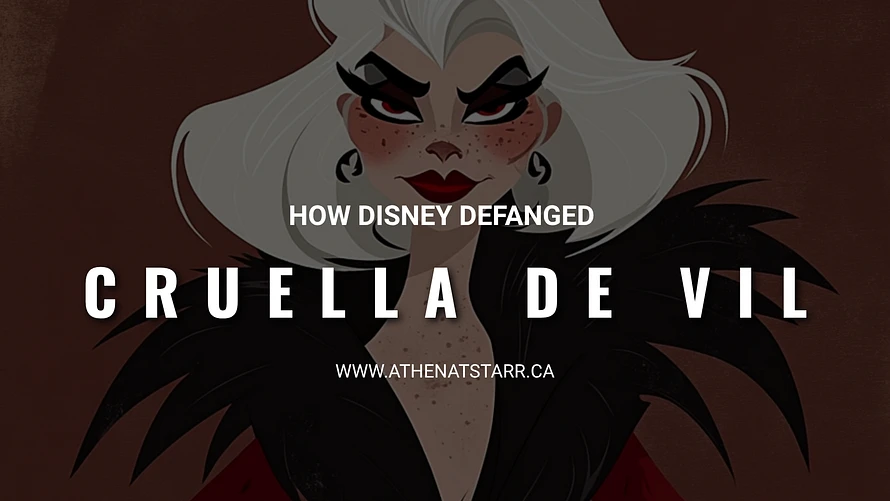
In the pantheon of Disney villains, Cruella De Vil stood apart with a unique and disturbing brand of evil. The 1961 animated "101 Dalmatians" gave us a villain who didn't want to rule kingdoms, cast spells, or seek revenge. No, Cruella's desires were far more terrifyingly mundane: she wanted to slaughter puppies to make a coat.
This wasn't about power or vengeance—it was about fashion, darling. And that made her somehow more disturbing than any witch or sorcerer in Disney's arsenal.
Betty Lou Gerson's legendary vocal performance created a character of pure, unrepentant materialism elevated to madness. Each drawn-out syllable of "dahhling" dripped with aristocratic disdain, while her manic obsession with fur emerged in every cackle. Her skeletal figure, stark black and white hair, and perpetual cloud of green cigarette smoke created an unforgettable silhouette of sophisticated malevolence. This was high society gone horribly wrong—wealth and privilege twisted into something monstrous yet fashionable.
What made the original Cruella so effective was her complete lack of justification for her actions. "I live for furs, I worship furs" wasn't delivered as an explanation—it was a declaration of faith. She saw absolutely nothing wrong with skinning puppies alive for fashion. There was no tragic backstory, no revenge plot, no misunderstood motivation. She was simply a sociopath who valued her wardrobe above living creatures, and she was utterly comfortable with that choice. Her lack of internal conflict made her external conflicts more terrifying.
The character's influence on fashion-obsessed villainy can't be overstated. She created the template for the "fashion monster"—someone who takes society's obsession with appearance and style to its logical, horrifying extreme. Her character suggested that true evil doesn't need supernatural powers or grand schemes; sometimes it just needs a great outfit and complete moral bankruptcy. The fact that she was essentially a well-dressed serial killer made her stand out in Disney's gallery of magical antagonists.
Enter 2021's "Cruella," where Disney decided this puppy-skinning sociopath needed... a redemptive origin story. Emma Stone's portrayal transformed our fashion-obsessed villain into a scrappy underdog fighting against the establishment. The movie performs incredible narrative gymnastics to explain away every element that made the original character effective. Her iconic black and white hair? Natural, not a fashion choice. Her cruelty to dogs? Just an act, part of a elaborate revenge scheme. Her obsession with dalmatian fur? Reframed as a symbolic attack on her enemy, not genuine desire.
The film's attempts to make Cruella sympathetic reveal everything wrong with modern villain origin stories. Every sharp edge is carefully sanded down. Her class-based cruelty is replaced with justified rebellion against upper-class corruption. Her genuine madness becomes performative artistic expression. Even her signature cigarette holder is mostly absent, heaven forbid our antihero have an actual vice. The result feels less like an origin story and more like character assassination in reverse—taking someone gloriously evil and trying to prove she was good all along.
Most egregiously, the film had to completely dodge the central element that made Cruella terrifying: her willingness to murder puppies for fashion. The original character's casual attitude toward animal cruelty made her uniquely disturbing. The new version not only loves dogs but is actually protected by them. It's like reimagining Hannibal Lecter as a misunderstood vegan chef or making Michael Myers a misunderstood Halloween enthusiast who just wants to give people a good scare.
The transformation extends beyond character to aesthetics. The original Cruella's appearance was a warning sign—her harsh angles and severe color scheme telegraphed her internal corruption. The new version turns her into a punk fashion icon, someone whose outrageous looks are meant to inspire rather than disturb. While visually stunning, these costumes miss the point that Cruella's fashion sense was supposed to be as morally bankrupt as she was.
What's particularly frustrating is how this reimagining diminishes the original's commentary on vanity and materialism. The 1961 Cruella was a savage satire of fashion industry excess and consumer culture—someone who took society's obsession with appearance to its logical, horrifying conclusion. The 2021 version instead celebrates fashion rebellion while trying to maintain its protagonist's moral purity. It's a have-your-cake-and-wear-it-too approach that undermines any meaningful commentary.
The film's success reveals an uncomfortable truth about modern audiences: we've become so obsessed with understanding and sympathizing with villains that we've lost the ability to appreciate pure, unapologetic evil. Not every villain needs or deserves redemption. Sometimes a character works precisely because they represent something irredeemable—in Cruella's case, the ultimate triumph of style over morality, of wanting to look good at any cost.
In trying to humanize Cruella, Disney didn't just kill her mystique; they skinned it, turned it into a fashionable coat, and paraded it down the runway of missed opportunities. The woman who once would have murdered a hundred puppies for a fashion statement became someone who wouldn't hurt a fly unless it was wearing last season's colors. While Emma Stone's performance is undeniably entertaining, it serves a character who is Cruella in name only—a pretender wearing the skin of a much more interesting villain.
Perhaps the most ironic thing about Cruella's transformation is how it mirrors the fashion industry's own tendency to take something shocking and dangerous and turn it into something safely marketable. Just as punk rock was eventually sold at the mall, Disney took their most fashionably evil villain and turned her into a Hot Topic-friendly rebel with a cause. In doing so, they proved that sometimes the cruelest thing you can do to a great villain is try to make them nice.
XOXO
Athena Starr